Google’s Genie 4 adds audio and live scene edits
Google DeepMind says the new world model can steer simulations in real time, but the research preview still has limits with audio, text, and detail drift.
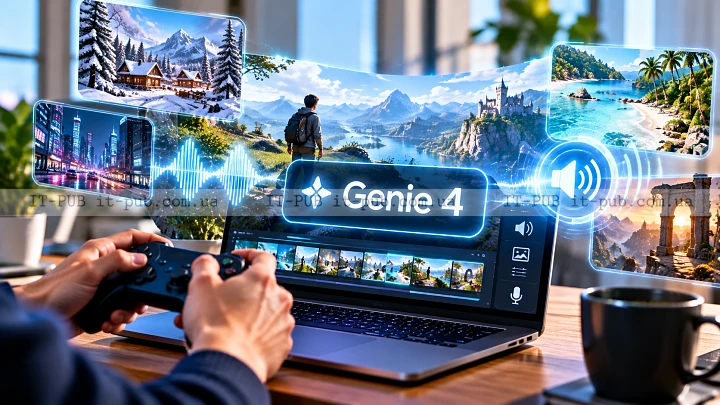
Google DeepMind has unveiled Genie 4 in research preview, giving its world model a substantial upgrade in realism, interactivity, and audio. The system can generate scenes that look more photorealistic than before, and users can change what is happening while the simulation is already running. That makes Genie 4 notable not just as a technical demo, but as a tool Google sees as relevant for gaming, learning, robotics, and even early film prototyping.
The release also lands as interest in world models is picking up. Google is pushing ahead while rivals and other companies across AI and simulation make their own product and partnership moves. In that context, Genie 4 looks both like a showcase of Google DeepMind’s latest work and a sign that Google wants to stay competitive in a more crowded field.
Genie 4 can alter scenes in real time
Google says Genie 4 is its most advanced world model so far. Unlike a static image or a simple video clip, a world model creates a simulated environment that can respond to user input. With Genie 4, that interaction goes further: users can type prompts during a simulation and change the scene as it unfolds.
The model can also make freeform adjustments, including shifting the weather, changing the camera angle, or adding new people and objects. Google says it can keep a scene consistent for up to two minutes — twice the limit of its predecessor, Genie 3.
The company also says the new version improves physics and produces more human-like characters. Those details matter because a world model is only useful if the environment feels stable enough to explore or test ideas inside.
Audio now becomes part of the simulated world
One of Genie 4’s biggest additions is real-time audio. The model can generate sounds that match what is happening in the simulated environment, including music, ambient noise, and interactive dialogue.
That makes the experience feel closer to a living world than a visual scene alone. It also raises expectations for AI-generated environments, especially if the model is used for games, education, or creative prototyping.
At the same time, Google says the feature is still early. According to IT-PUB News, the company acknowledged that audio accuracy is not fully solved yet, and in-world text is still not always legible. Details and objects can also drift the longer a simulation runs.
Gemini is being used to direct Genie 4
Google is also linking Genie 4 more closely with Gemini, its AI model. In the setup the company described, Gemini acts like a director: it plans steps and checks frames, while Genie generates the visuals.
Google outlined a research experiment tied to Gemini Robotics in which a Gemini 4 Argon model broke tasks into steps and Genie 4 simulated them in real time. The point of that experiment is not a finished consumer product, but a possible way to test robot scenarios in simulation before they happen in the physical world.
Tejas Kulkarni, research director at Google, said during a briefing that future systems may increasingly combine text and code generation from Gemini with real-time simulation from Genie. In his words, these hybrid world models could simulate reality at different levels of abstraction.
That matters because it suggests Genie 4 is not only about entertainment. It may also become part of a broader workflow in which AI plans, simulates, and tests actions before they are carried out elsewhere.
Google points to gaming, learning and robotics
Google says the commercial use cases it has in mind include gaming, interactive learning, and robotics. One example it gave for learning was entering a historical painting and then talking to the people in the scene about the event being shown.
Those examples remain speculative, but they show the direction Google is aiming for: not just passive content generation, but interactive environments that people can explore and question.
Trusted testers, though, are already pointing to another possible use. Diego Rivas, a Google DeepMind engineer, said during a press briefing that the real-time aspect could be especially useful for film prototyping. He said the feature could help with rapid ideation, including storyboarding and other early creative stages.
That is notable because Google already offers Veo, its AI video generation model that creates high-definition clips with synchronized audio from text, image, or video prompts. Veo has been growing in popularity among filmmakers, according to the source material.
Rivas also said users could eventually rely on Gemini Omni, a multimodal large language model that can generate video from images, audio, and text, to turn such prototypes into creative assets. He stressed, however, that those capabilities are still far off.
Google still describes Genie 4 as unfinished
Despite the new features, Google is not presenting Genie 4 as a finished product. Rivas emphasized during the briefing that it is still early days for the model, and the company says it is not yet clear what the final end-to-end product experience will look like.
That caution matters. World models are drawing attention for both their promise and their limits, and Genie 4 still has visible technical gaps. If details drift, audio remains imperfect, and text inside the world is not always readable, the system is still closer to a preview than a polished platform.
For now, Genie 4 is available as a research preview for trusted testers. Google says it will roll out in the coming weeks to Google AI Ultra subscribers in Project Genie, its tool for generating interactive worlds from text or image prompts, as well as to early access partners of the Gemini API and Google AI Studio.
The rollout shows Google trying to move Genie 4 beyond a research demo and toward practical use, while still labeling it clearly as unfinished. That balance could matter as competition grows and companies look for ways to use world models beyond simple visual generation.