Google rolls out WeatherNext 3 forecasts
Google says its new AI weather model will power Search, Maps and Gemini, with higher-resolution forecasts and hourly updates.
Google has introduced WeatherNext 3, a new AI model for weather forecasting that the company says is more accurate, faster and more detailed than earlier systems. The model is set to shape weather information shown in Google Search, Google Maps and Gemini, while also being offered through Google’s cloud platforms. That gives the launch weight beyond a research update. Weather forecasts affect daily decisions for users and planning choices for industries from farming to energy.
The release also points to a wider shift in meteorology. AI is moving from a research tool into products that millions of people may use directly.
WeatherNext 3 will feed Google products
Google describes WeatherNext 3 as the latest step in a broader change in weather forecasting driven by deep learning. Samier Merchant, a Google senior staff engineer, said this will be the first time some of the core variables behind the model will power many Google products.
So this is not just a lab project or a specialist tool. Google plans to use the model in consumer services, where weather information can influence how people plan their day and make quick decisions about timing, routes and activities.
The company also said the model will be available to users and researchers through its cloud platforms. That gives WeatherNext 3 a dual role — part of Google’s own consumer services, and part of a wider research and business offering.
Google says it outperforms other forecast models
Google says WeatherNext 3 has already posted strong results in testing. On Operational WeatherBench, a benchmark created by startup Brightband to compare AI weather forecasts, the model ranked as the most accurate among leading contenders.
The benchmark measures variables including temperature, wind speed and humidity. According to IT-PUB News, Google says WeatherNext 3 outperformed other deep-learning models from Google, Microsoft, Nvidia and the European Center for Medium-Range Weather Forecasting, as well as traditional forecasts from the U.S. National Weather Service and the ECMWF.
That claim is likely to attract attention. Weather forecasting has long been dominated by government supercomputers running physics-based models. Those systems are highly capable, but they are also expensive and slower than newer AI approaches. Google’s results suggest AI models are increasingly challenging that older forecasting model, especially where speed and cost matter.
Higher resolution and hourly updates are the key upgrades
Google says WeatherNext 3 tackles some of the weaknesses that have limited AI weather models so far. Earlier models often worked at a scale that was too broad for practical forecasting, were less reliable with rain, and still depended heavily on formatted data from government agencies.
WeatherNext 3 is meant to improve on those points. Google says it can forecast at a 5 km resolution for key variables, compared with broader coverage in earlier systems. Its rain evaluations are 60% better than WeatherNext 2, and it can now generate hourly forecasts instead of the usual six-hour interval.
Those changes sound technical, but they have practical consequences. More detailed forecasts can be more useful for local decisions, while more frequent updates can better reflect fast-changing weather. That matters when conditions shift quickly and small changes can alter plans.
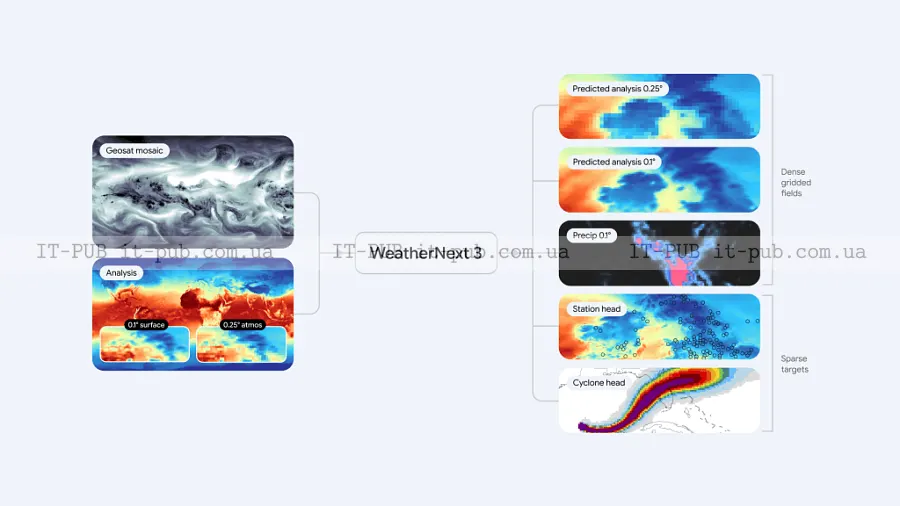
The model is also larger than its predecessor, with 2.4 times more parameters. Google says the team adjusted the decoder heads to produce more useful outputs and trained the model to target specific weather data stations. That helps with finer predictions and with evaluation against ground-truth measurements.
Daniel Rothenberg, an atmospheric scientist at Brightband, said this kind of approach brings forecasting closer to the core task. He pointed to the value of predicting what a specific station — such as one at Denver’s airport — will measure on an hourly basis.
Raw satellite data is the next battleground
One of the more notable technical changes in WeatherNext 3 is its ability to ingest weather satellite data collected in real time on an hourly basis. Google says that makes more frequent forecasting possible.
The company also says WeatherNext 3 is the first AI model to directly incorporate raw observations for a high-resolution global forecast. That claim is disputed. AI weather startup WindBorne says its model, WeatherMesh 6, has been using raw observations from weather balloons and other sources since late 2025.
Google responded by saying its forecasts are higher resolution across the globe. Even so, the source material notes that both models still rely on national weather datasets to make forecasts, meaning true direct data assimilation is not yet solved.
That helps explain where competition in AI weather forecasting is heading. The race is no longer just about whether AI can match traditional forecasting. It is also about how directly models can work with live observations, and how much they still depend on the older infrastructure behind weather prediction.
Why AI weather forecasting is drawing wider interest
WeatherNext 3 arrives as AI forecasting draws more attention well beyond the weather industry. European and U.S. weather agencies are already using AI models in their forecast products, and the main appeal is straightforward: these systems are faster and cheaper to run than supercomputer-based alternatives.
That lower cost could matter far beyond wealthy countries with advanced forecasting infrastructure. The source notes that the speed and affordability of AI forecasts may bring economic benefits to poorer regions, where expensive sensors and supercomputers have made high-quality forecasts harder to access.
The practical uses go beyond daily weather alerts. Bill Gates recently cited AI-powered weather forecasting as an important benefit of the technology, saying better forecasts can improve crop yields in developing countries. Ferran Alet, a DeepMind research scientist manager, said higher-resolution forecasts of wind, rain and cloud cover could also help make renewable energy projects more dependable.
Google’s own framing is more restrained, but still broad. Alet said the company’s goal is to provide useful information to users, and weather is a major part of that. With WeatherNext 3, Google is betting that a better forecast is not just a scientific result, but something people will notice in products they already use.