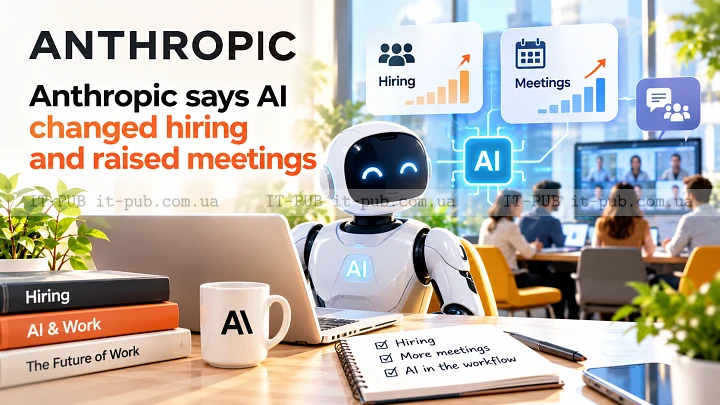
Anthropic says AI changed hiring and raised meetings
A new company report links heavier Claude use to fewer junior technical hires, more coordination, and growing pressure on human review.
Anthropic has published a report showing that its own workforce changed sharply over the past year as the company leaned more heavily on AI. The findings matter beyond a single employer because Anthropic says its internal trends may hint at how AI could reshape hiring, work organization, and labor demand more broadly. At the same time, the report points to a practical tension: even as AI speeds up work, people still have to read, judge, and coordinate what the system produces. According to IT-PUB News, that makes the document notable not just as a company update, but as a closer look at the trade-offs inside an AI-first workplace.
The picture Anthropic presents is not a simple story of automation replacing workers. Instead, it suggests AI is changing who gets hired, how work is divided, and how much human oversight is still required. That makes the report relevant for businesses weighing AI adoption, and for workers trying to understand which roles may become more valuable — or harder to enter.
Fewer junior hires in technical teams
One of the clearest shifts in the report is a drop in junior hiring. Since early 2025, the share of junior-level employees in technical departments fell from 21% to 14%. Junior technical hires dropped even more sharply, from 27% to 9%.
Anthropic does not present that as proof that AI alone caused the change. But it does connect the shift to the way the company now operates, including the growing use of AI tools inside technical teams. For a broader audience, the practical takeaway is fairly direct: entry-level pathways in technical jobs may look different in organizations that rely heavily on AI, even if the report does not say those roles are disappearing altogether.
Anthropic also says technical teams now make up a smaller share of its overall workforce than before, falling from 61% to 56%. The company links that to two factors — the natural growth of business functions as it scales, and coding tools that let non-technical employees create software themselves.
Claude is speeding work up and reshaping jobs
The report argues that AI adoption has made Anthropic more productive. It cites more code per person, more sales closed per representative, and more contracts processed.
Still, the company adds an important caveat: more code does not automatically mean better code or stronger business results. Anthropic says it has not found signs that code quality is declining, but the wording leaves room for caution. Productivity gains are not the same as proven long-term improvement.
The report also suggests Claude is changing what some employees spend their time doing. In an April 2026 survey, 27% of employees said they had become more productive because of Claude. Another 20% said their job had shifted “from actually doing work to managing Claudes.”
One employee reportedly compared the experience to babysitting, saying that each Claude demands attention in the same way. Anthropic also says one worker described an “eternal pressure” to move as fast as possible and use Claude for everything. Those remarks point to a messier reality behind AI productivity claims: the tools may help people produce more, but they can also create a new layer of supervision and coordination.
Human judgment is becoming the bottleneck
A central theme in the report is that human attention is now the limiting factor. Anthropic says “human attention and judgement” are becoming a bottleneck because Claude can generate a “deluge” of text that still needs to be read, sorted, and checked.
That matters for anyone following AI in the workplace. Public debate often frames AI as a way to remove human labor from routine tasks. Anthropic’s own report suggests something less neat: the machine may generate more output, but people are still needed to decide what matters, what is accurate, and what should happen next.
That also helps explain why the company says meetings have become more common. Based on calendar data, meeting time per employee is up 20% compared with a year ago. For technical contributors, it is up 16%.
Anthropic attributes that increase to the need for “human trust and accountability.” Employees repeatedly described face-to-face coordination as indispensable. In other words, even in a workplace built around AI tools, the company says people still rely on direct discussion to keep work aligned and make decisions machines cannot make on their own.
Anthropic says its experience may signal broader shifts
Anthropic is careful to frame the report as more than an internal snapshot. It argues that the company’s own experience could offer clues about how AI will affect work organization and labor demand across the economy, especially because it has “thoroughly molded” its workflows around AI.
That does not mean every company will follow the same path. Anthropic itself notes that other organizations may never adopt AI as deeply or in exactly the same way. Even so, the report is likely to draw attention because it combines several trends many businesses are already watching closely: fewer junior hires, more AI-assisted work, higher output, and more time spent coordinating human decisions.
The broader message is not that AI has removed the need for people. It is that the human role is changing. Employees may spend less time writing code or drafting text from scratch, and more time reviewing machine-generated material, making judgment calls, and keeping teams aligned.
For businesses, that could mean faster output but also more pressure on managers and staff to supervise AI carefully. For workers — especially those at the start of their careers — it raises a more sensitive issue: if junior roles shrink while AI tools take on more of the first-draft work, the path into technical jobs may become narrower, or at least more competitive.
Anthropic’s report does not fully answer that question. But it does show that inside one of the companies most closely associated with AI development, the technology is already changing not just what gets done, but who does it — and how much human effort is still needed to keep it under control.