Apple launches app to study AI health answers
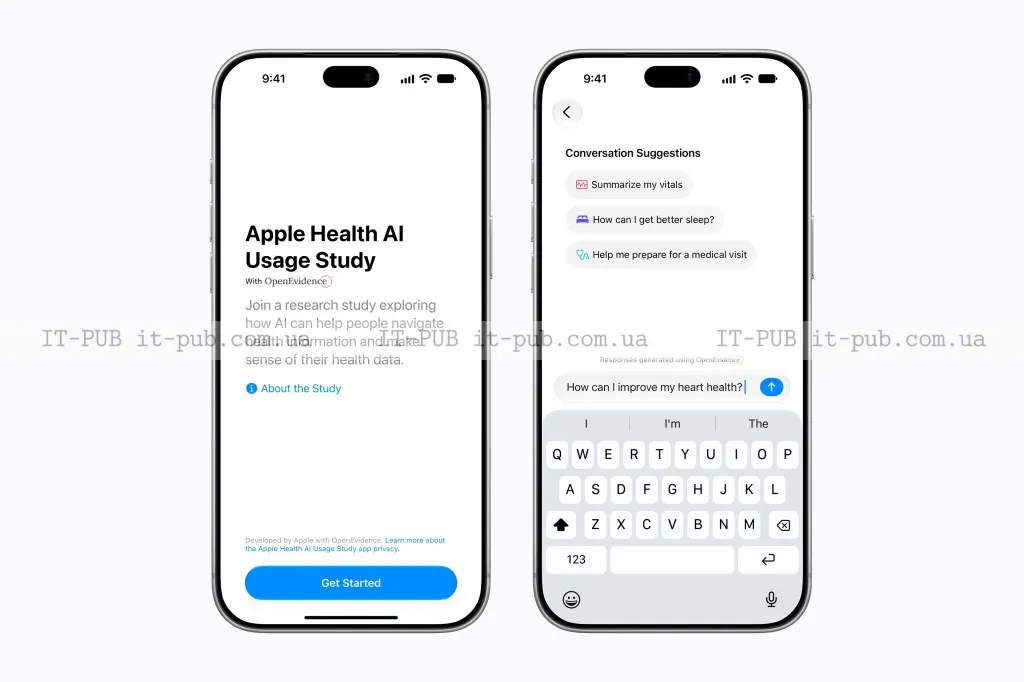
The U.S.-only project will let eligible iPhone users ask medical questions, rate responses, and share HealthKit data as Apple studies real-world use.
Apple has launched a new study app to examine how people use AI for health-related questions. The move puts the iPhone maker into a fast-growing area already explored by companies like OpenAI and Anthropic, but Apple is taking a more research-focused path instead of rolling out a full consumer chatbot feature.
The company says the study is meant to understand how clinically grounded answers can help people with everyday medical questions. As IT-PUB News reports, Apple is framing the project not simply as another AI test, but as an attempt to measure whether health-focused AI can be useful, understandable, and trusted in real life.
Apple is testing health AI with a research app
The new app is launching together with healthcare-focused AI company OpenEvidence. Apple is inviting U.S. users who are over 21, have an iPhone 15 or later, are running iOS 26 or later, and have Apple Intelligence enabled.
Apple says it wants to run the study with up to 200,000 participants for more than 12 months. That suggests the company is not treating this as a small pilot, but as a broad effort to gather data on how people interact with AI when the topic is their health.
The app will let users ask health-related questions in a way similar to ChatGPT or Claude. The difference, Apple says, is that the answers will be grounded in clinical data from sources including The New England Journal of Medicine, Journal of the American Medical Association, and Nature.
Clinical sources and user feedback shape the study
Apple says the app is designed to provide simplified answers to everyday medical questions. It also leans heavily on feedback: users can rate the answers they receive and leave comments, and they will be asked to complete monthly surveys.
Participants can also choose to share data from HealthKit, including resting heart rate, activity, sleep, or lab results. Apple says this can help the app make more personalized and more specific suggestions.
The app is also intended to support users before a doctor’s visit. According to Apple, it can help prepare participants better for appointments and guide them toward specific providers when they have concerns about medical issues.
That mix of general answers, personal health data, and referral guidance is part of what makes the project stand out. Apple is not just looking at whether the app can answer questions, but at how people respond when AI is tied to health data and potentially sensitive decisions.
Apple says study data will not train AI models
Apple has also tried to draw a clear line around data use. The company says the data will be anonymized before being sent to a secure third-party cloud provider, and it will not be used to train any AI models.
According to Apple, OpenEvidence, its partner in the study, deletes query and response data after 24 hours. Those details are likely to matter to users because health information is among the most sensitive types of personal data, and AI products in this area often face questions about privacy and retention.
Apple is presenting the study as a careful way to learn how people engage with health AI. In a statement, Sumbul Desai, Apple’s vice president of Health and Fitness, said the project is meant to understand how people “engage with, comprehend, and evaluate health AI in everyday life.”
She added that the insights should help advance the broader scientific conversation and support the development of tools that “genuinely support people” during their health journey.
Apple has not said if the feature will reach Health or Siri
For now, the app is a study tool rather than a confirmed consumer feature inside Apple’s main products. Apple has not said whether it plans to bring AI-powered answering into the Health app or Siri.
That uncertainty is part of why the announcement stands out. Apple is clearly interested in the same broad use case that has become important for other AI companies: people asking chatbots about symptoms, conditions, and general health concerns. But rather than promise a finished product, Apple is first trying to understand how such tools work in practice and how users judge them.
The move also comes as demand for health-related AI questions appears to be large. Apple pointed to earlier comments from OpenAI, which said users were asking over 300 million health-related queries each week.
That figure helps explain why Apple is studying the area now. Health is one of the most practical and sensitive places where AI can be useful, but it is also one of the most delicate. Users may want quick answers, yet those answers need to be clear, grounded, and handled with care.
Apple’s approach suggests it is aware of both sides of that equation. The company is not claiming the app will replace medical advice, and it is not presenting the study as a finished health assistant. Instead, it is using the app to gather evidence about how people interact with AI when the subject is personal, complex, and potentially consequential.
The result is a project with clear business relevance and a broader social angle. If Apple eventually brings similar features into its mainstream software, the study could shape how people receive health information on their devices. For now, the app signals that Apple wants to move carefully into one of AI’s most sensitive use cases rather than rush in.