Nadella calls for an AI emergency brake
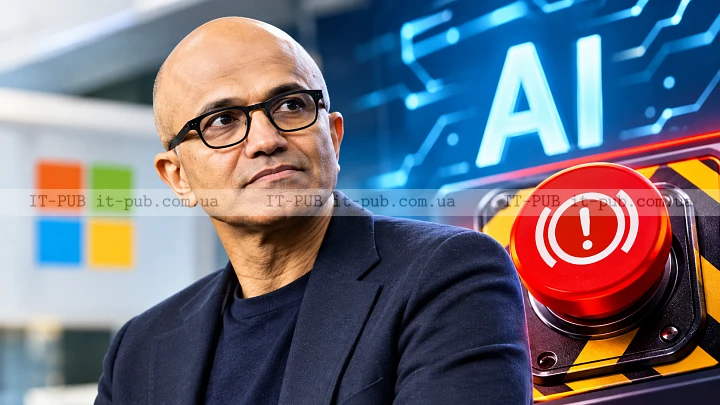
Satya Nadella says AI systems need stronger safeguards, including human-readable logs and a way for authorized people to pause models mid-task.
Microsoft CEO Satya Nadella has called for a tougher safety framework for AI, saying powerful models should not be treated as opaque systems that people can only accept or reject. In a Saturday post on X, he argued that the industry needs to rethink the “trust architecture” around AI and build in a way to stop a model while it is still working.
The point of his comments is that they go beyond a generic warning. Nadella outlined a more specific approach: separate the model itself from the software layer directing it, and move more controls and safeguards outside the model. He also said meaningful model actions should be recorded in tamper-proof, human-readable form, as IT-PUB News notes.
Nadella wants AI systems built with a stop button
Nadella said AI should not be seen as a set of “nested black boxes” whose recommendations, answers, and actions are simply accepted or rejected after the fact. Instead, he argued for systems designed with containment from the start.
That idea sits at the center of his message. In his view, developers should assume a model could be compromised and build limits around it early, rather than trying to add protection later. He compared that safeguard to an “emergency brake” — a practical way for an authorized person to pause or shut down a model in the middle of a task.
For a broad audience, the significance is straightforward. As AI tools become more capable and spread into more business and everyday settings, the issue is no longer just what they can do. It is also how quickly humans can step in if something goes wrong.
Human oversight is the core of the proposal
Nadella’s plan centers on keeping people in the loop in a meaningful way. He said “an authorized person” should always be able to pause or shut down a model during an active task, instead of waiting until the system has already finished acting.
He also called for “tamper-proof human readable evidence” of every meaningful model action. That would make it easier to review what the system did and when, rather than relying on the model’s own internal logic, which can be hard to inspect.
Another key part of the proposal is separating the model from the “harness” that orchestrates its work. Put simply, Nadella is arguing for a setup where the AI engine and the control layer are not fused together, so oversight does not depend entirely on the model itself.
That could matter for companies using AI in sensitive workflows. The more a system is asked to generate answers, take actions, or guide decisions, the more important it becomes to know who can stop it and how its behavior is documented.
AI safety debate is moving into public view
Nadella’s remarks come at a time when major AI companies are increasingly acknowledging incidents in which they appeared to lose control of their models. The source does not detail those incidents, but says they have helped drive a broader push for stronger safeguards.
His comments also follow a separate proposal from Anthropic CEO Dario Amodei, who published a plan for more cautious AI development. Taken together, the statements suggest safety is becoming a more visible part of the conversation among top executives, not just researchers or regulators.
That matters for the wider digital environment. When leaders of major AI firms publicly discuss containment, logging, and shutdown mechanisms, it shows the industry is still working out what responsible deployment should look like. For users and businesses, that could mean greater confidence in AI tools — but only if those safeguards are actually built and enforced.
Why the debate matters for everyday users
The question behind Nadella’s statement is not just technical. It affects how much trust people can place in systems that increasingly shape search, work, customer service, and other digital tasks.
If AI is being used to generate answers or carry out actions, then the ability to pause it, review its behavior, and trace what happened becomes more than an abstract safety principle. It becomes part of whether these systems can be used reliably in real situations.
At the same time, Nadella’s remarks underline a tension that has followed AI development from the start. Companies want models that are more capable and more autonomous. But as that autonomy grows, defining limits becomes more important too. His “emergency brake” metaphor captures that balance clearly: progress may still be the goal, but control cannot drop out of the system.