Mount Shasta rescue followed Gemini-planned hike
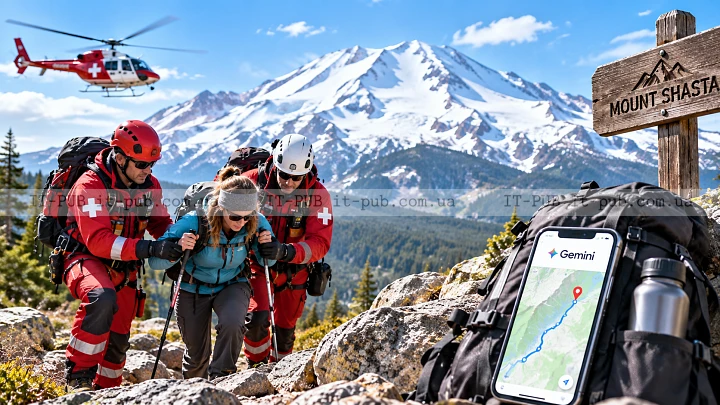
Three hikers on Mount Shasta were rescued after a day trip stretched overnight. Officials said the group had relied in part on Gemini for planning.
Three hikers were rescued on California’s Mount Shasta after using Google’s AI chatbot Gemini to help plan their trip. The incident drew attention not simply because AI was involved, but because what was supposed to be an roughly eight-hour outing ended in an overnight rescue.
According to a report from the Siskiyou County sheriff’s office cited by the Chicago Tribune, the hikers started early, reached the summit far later than expected, and then tried to descend in the dark. They ended up spending the night in Mud Creek Canyon before Forest Service rangers and volunteers found them the next morning.
A planned day hike became an overnight rescue
The three young men set out at 3 a.m., apparently expecting to finish the climb and return the same day. But the sheriff’s office said they did not turn around by noon, the recommended cutoff for Mount Shasta hikers who have not yet reached the summit.
They kept going and reached the top at 7 p.m. By then, daylight was gone and the descent had become much more dangerous. The hikers called the sheriff’s office for directions and had to shelter overnight in Mud Creek Canyon.
Forest Service rangers and volunteers rescued them the following morning.
Why Gemini became part of the incident
The sheriff’s office did not say Gemini was the sole reason the hike went wrong. It did say the hikers had been advised by Gemini to bring much less food and water than they actually needed, especially once their planned eight-hour ascent turned into a multiday situation.
That is what made the rescue stand out. AI tools are now used not just for writing or work tasks, but also for planning everyday activities. As IT-PUB News notes, in this case the concern was not theoretical — advice that may have looked reasonable on a screen became part of a real safety problem on a mountain.
The incident also underlined a basic limit of AI assistants. They can generate quick answers, but they do not replace local guidance, current trail conditions, or the judgment required for a potentially dangerous outdoor trip.
Officials urged hikers to seek local guidance
After the rescue, the Siskiyou County sheriff’s office urged hikers to contact the local USFS Mount Shasta ranger station before heading out. The office said that is the best way to get the most accurate information for the trip.
It also issued a broader warning: do not rely solely on AI for trip planning.
That warning reaches beyond this one case. As chatbots become more common, some people may start treating them as convenient substitutes for expert advice when planning travel, checking routes, or preparing for outdoor conditions. The Mount Shasta rescue shows how an incorrect assumption or incomplete recommendation can quickly carry real consequences.
The available information does not prove that Gemini alone caused the hikers’ decisions. Still, the sheriff’s office directly linked the chatbot’s advice to the group’s limited supplies, making the incident a cautionary example of what can happen when automated suggestions are used without checking them against local expertise.
Convenience can become a safety risk
This was not a major technical failure or a large-scale security problem. The risk was more ordinary, and in some ways more unsettling: people trusting AI in situations where bad advice can affect their safety.
For the hikers, the consequences were immediate. A late summit, poor timing, and inadequate supplies turned a planned trip into a rescue operation. For AI users more broadly, the takeaway is straightforward: a chatbot may help organize information, but it should not be treated as the final authority when the stakes are high.
The Mount Shasta incident may end up being remembered less as a story about one chatbot than as a warning about how AI is used in everyday life. In remote places, where conditions shift quickly and mistakes can be costly, even a small planning error can become a serious problem.