Electric Plant raises $11.2M for plant signal AI
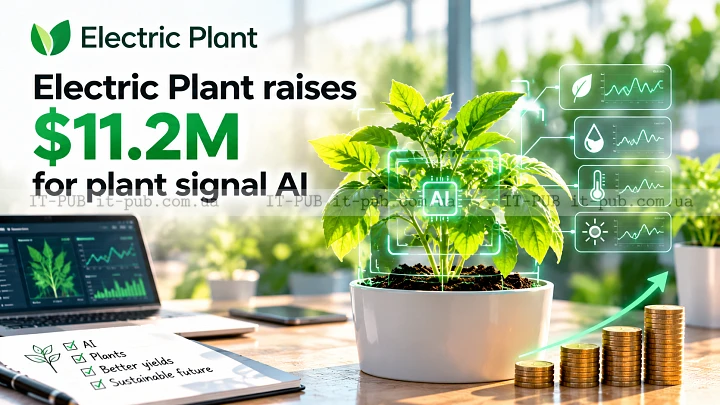
The startup says its sensors and Bombadil model can read electrical activity inside plants, helping growers fine-tune water and fertilizer use.
Justin Mast says a chance encounter with research on a “cyborg plant” pushed him to build a company around an unusual idea: plants emit electrical signals that can be read and translated. That company, Electric Plant, has now raised $11.2 million to keep developing the technology and bring its sensors and AI model, Bombadil, to market. As IT-PUB News reports, the startup is pitching a different approach to crop monitoring — one that focuses on what is happening inside the plant itself. For farmers, growers, and foresters, that could offer a more direct view of what crops need in real time.
Electric Plant is built around plant electrical signals
Mast said the idea traces back to scientific research involving a houseplant wired to a motorized stand that moved toward light when electrical signals showed it needed more of it. He later teamed up with Lee von Kraus, a neuroscientist who has worked with DARPA, to found Electric Plant.
Over the past three years, the company has been collecting data to train Bombadil, which it describes as a large language model for plant electrical activity. According to the founders, the model is designed to interpret subtle electrical signals moving through a plant’s stem and turn them into information growers can actually use.
Mast says the company’s long-term goal goes beyond monitoring. He believes the technology could eventually make it possible for people to “speak” to plants, though he also stressed that, for now, the focus is on listening first.
How Electric Plant says its sensors work
Electric Plant’s sensors are attached directly to plants with stainless steel screws. Those screws have to reach the cambium — the living tissue just beneath the bark — so the device can detect microvolt changes inside the plant.
According to Mast, the sensors are about the size of a regular iPhone folded lengthwise. They send data over a low-power wireless network to a base station, and that information is then processed in the cloud by Bombadil. The results are sent back to the customer, who can use them to adjust watering or fertilizer schedules.
Mast also said the company needs only a couple of sensors per acre to get accurate results. He added that the hardware is far cheaper than existing tools, which generally cost thousands of dollars, while Electric Plant’s sensors cost “tens of dollars.”
Why the company thinks growers will care
Electric Plant argues that current tools still leave a gap between what growers can measure and what the plant is actually experiencing. Mast said that even in carefully controlled greenhouses, farmers and growers still do not have full visibility into what their plants require.
He described methods such as soil probes, handheld spectroscopes, and satellite imagery as useful but limited. In his view, they can help estimate what a plant needs, but they do not provide a direct readout from the plant itself.
The company says it started by using those same devices to help train Bombadil. Electric Plant says the model can now interpret electrical signals in about 125 species, including ferns, redwoods, tomatoes, and dahlias.
Mast claims the system could improve yields while reducing water use by 20% or more. That is a substantial promise in agriculture, where water use and crop efficiency are major concerns, though the company has not disclosed who its first customers are.
The new funding gives Electric Plant room to scale
To push the technology closer to market, Electric Plant recently raised an $11.2 million seed round. The round was led by Onto Ventures and Climactic, with participation from Ponderosa, Endeavor Catalyst, Ludlow, Michigan Rise, The Fund, Schox VC, and Dug Song.
The raise suggests investors are willing to back a concept that sits between agriculture technology and bio-sensing research. It also gives the company more resources to refine its sensors, expand its model, and test whether the system can work outside the lab.
Still, the claims invite caution. The idea of decoding plant “language” is eye-catching, but the source material makes clear that the system is about interpreting electrical signals, not literally translating thoughts or emotions. Its value will depend on how accurately it can guide decisions in real growing conditions.
Electric Plant is betting on a more direct read of biology
Electric Plant presents its work as a step toward a more direct way of understanding living systems. Mast said Bombadil is the “most diverse model ever created on biological electrical signals,” and added that no equivalent has been done in the animal world.
That claim captures both the novelty of the project and the uncertainty around it. If the technology works as promised, it could give growers a cheaper and more immediate window into plant health than many existing tools. If not, the effort still points to a basic problem in modern agriculture: much of it still depends on indirect measurements rather than the plant’s own signals.
For now, Electric Plant is betting that tiny electrical changes inside stems can become useful data. The next test is whether that unusual idea can hold up not just as a scientific curiosity, but as a practical tool for people growing crops and managing forests.