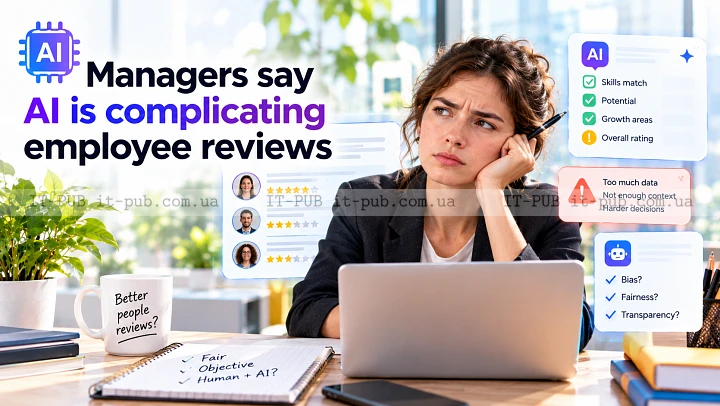
Managers say AI is complicating employee reviews
A Monday.com-commissioned survey of 1,700 managers found AI is adding oversight work, changing evaluation criteria, and raising bias concerns.
More than half of senior managers say AI has made it harder to judge employee performance, according to a new survey commissioned by Monday.com. The findings suggest that while companies are pushing AI to improve productivity, the technology is also creating a management problem: work is arriving in a more polished form, but it is not always clear how much came from the employee and how much came from AI. According to IT-PUB News, the issue reaches beyond efficiency and into how companies evaluate staff, supervise teams, and maintain trust in the work they receive.
The survey also points to a broader shift inside companies. AI is no longer just a tool for isolated tasks — it is starting to change how organizations operate.
Managers say AI makes work harder to assess
The survey, conducted by Nielsen among 1,700 directors and senior managers across seven countries, found that more than half of senior leaders now struggle more with evaluating employees after adopting AI tools. Nearly half said they spend more time than before reviewing and guiding team output.
A big part of that extra effort appears to come from the way AI changes the final product. Instead of rough drafts or unfinished work, managers often receive material that already looks polished. That can make it harder to tell whether the employee produced the work directly or relied heavily on AI.
The survey does not frame this as a rejection of AI. On the contrary, the managers surveyed were broadly positive about it. Ninety-four percent said they were excited about using AI to improve work, and many said they already know where it can deliver the most value.
Michal Miller Levi, head of market research and customer insights at Monday.com, told TechCrunch that the enthusiasm resembles the early days of the internet in the 2000s, when people saw a similar sense of “magic” in new technology. But, she said, companies are struggling to adapt because AI is moving faster than their internal processes.
AI skills are becoming part of performance
The survey suggests companies are already changing how they judge workers. Seventy-eight percent of respondents said they have adjusted their evaluation methods since adopting AI.
That means performance is no longer measured only by the final result. Managers are placing more value on whether employees can write effective prompts, decide which tasks should be handed over to AI, and experiment with new ways of working.
For employees, that is a meaningful shift. In some cases, the ability to use AI well may now matter as much as traditional execution. But the survey also raises a fairness problem: if managers cannot easily tell how much AI contributed to a piece of work, it becomes harder to assess the person behind it accurately.
The picture gets more complicated because many managers are also using AI to help make those judgments.
AI is now part of the review process
According to the survey, 46% of managers use AI to inform their decisions, and 39% of leaders use it to draft performance reviews. So AI is not only affecting the work being reviewed — it is also shaping the review process itself.
The report warns that this could introduce additional bias into performance assessments. Large language models are designed to predict likely responses, and they can reflect patterns found in the data they were trained on. The source cites research from the Luxembourg Institute of Socio-Economic Research earlier this year, which found that when there are no clear objective standards and people are rated separately, LLMs tend to rate performance similarly to humans.
It also points to an early-2025 research paper saying AI models can be biased against black male candidates and show significant bias across different social groups.
Asked whether AI could bring outside bias into performance reviews, Levi said companies have not yet figured out how to handle those issues. That leaves businesses with a difficult question: if AI is used to judge people, who is responsible for making sure the process remains fair?
More tools mean more oversight and hidden work
AI is also changing the daily workload of managers in less visible ways. Someone has to decide which tasks should go to AI agents, check their output, and step in when something goes wrong. The report describes this as a possible new layer of “invisible labor.”
At the same time, the software environment inside companies is becoming more complicated, not simpler. Fifty-seven percent of managers said their organizations now have more tools in circulation than before, while about 51% said those tools have become more interdependent and clustered since AI adoption. Only 29% described their AI infrastructure as fully optimized and centralized.
That runs against what many businesses expected. Levi said companies thought AI would help them reduce the number of tools they use. Instead, they are dealing with more apps, more integrations, and shadow AI usage as employees adopt tools outside approved company systems.
She said many managers ended 2025 expecting consolidation, but the opposite happened: the number of tools increased, and more than half of respondents said they are using more tools than last year.
Control is starting to matter more than speed
The survey suggests the next challenge may be less about productivity and more about control. As companies deploy AI agents that can act on their own, managers are starting to worry about how far that autonomy should go.
Fifty-eight percent of managers expect to oversee more AI agents than human employees within the next year. At the same time, 46% said they worry about losing control over what those agents do, and 35% said they fear being held responsible for decisions made by AI.
Levi said managers do not want their agents to be fully autonomous. Instead, they want people to stay involved and be consulted on important tasks and decisions.
The broader message from the report is that AI adoption is becoming as much a governance issue as a productivity one. Companies may be adopting these tools to save time and improve output, but without clear processes and the right infrastructure, managers are left trying to keep pace with systems that are changing faster than the rules around them.