Google opens Gemini and Search to more apps
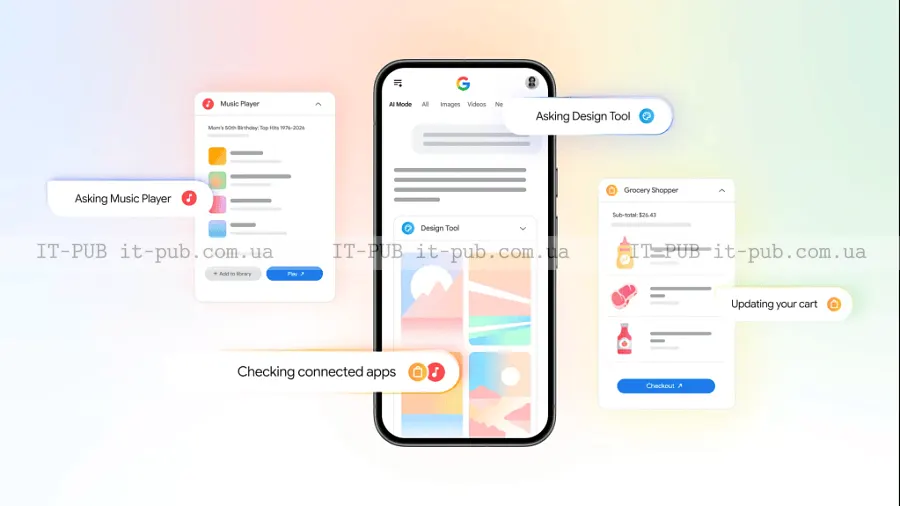
Google’s new Connected Apps Platform is in public preview in the U.S., giving developers a way to submit integrations for Gemini, Search, or both.
Google is widening the range of apps that can plug into its AI tools, giving businesses a new way to show up inside Gemini and Google Search. The company has launched a Connected Apps Platform that lets developers build, test, and submit integrations for its AI experiences. That matters because Google’s search and assistant-style products could increasingly become a gateway to third-party services, not just Google’s own tools.
The platform is now in public preview for developers in the U.S., though Google has not said when it will expand access more broadly. As IT-PUB News notes, the announcement also points to a larger shift in how people may use apps online: instead of opening separate services one by one, users may increasingly ask an AI interface to handle tasks across them.
Google is opening its AI products to more outside services
Google says connected apps let users securely link third-party services and then use them to carry out specific actions. The company gave examples such as connecting Canva to design a flyer or linking YouTube Music to build a playlist.
The idea itself is not unique to Google. Other consumer-facing AI services, including ChatGPT and Meta’s Muse, have also explored similar integrations. The broader premise is that AI platforms could become the main place where people discover and use digital services, rather than starting with standalone apps.
For that to happen, though, there needs to be a large enough ecosystem of connected services. Google is now trying to expand that ecosystem by opening the door to outside developers and businesses that want their apps to appear in Search or Gemini.
Developers can submit apps for Gemini, Search, or both
The Connected Apps Platform is aimed at businesses and developers that want to reach users through Google’s AI products. Google says they will be able to submit their own connected apps and monitor how they perform.
To get started, developers must integrate with a cloud-hosted MCP server or Android MCP using the AppFunctions APIs. They then use the Google Connected Console to register, test, and submit the app.
Once submitted, an app can be made available in Search, in the Gemini app, or in both. Google describes this as a way to connect a developer’s service with its AI features, so users can reach it through the company’s products.
Google also says developers will be able to track traffic, latency, and error rates after an app goes live. At the same time, they keep control over brand identity, including verified logos and authenticated accounts.
More connected apps are coming to Google Search
Google already has more than 50 Connected Apps available in Gemini. Those include partners such as Adobe, Experian, Localiza, and Peloton, along with Google’s own services like Workplace, Photos, YouTube Music, and Google Home.
Now those apps are set to come to Google Search over the next few weeks. Search currently has fewer integrations than Gemini, with apps such as Instacart, Canva, YouTube Music, and Yahoo Fantasy Football already featured there.
Google also said that Calm is joining the effort as a new partner, and that its app will soon be available in both Gemini and Search.
The expansion suggests Google wants its AI products to become a more central place for everyday tasks, from media and shopping to productivity and services. For businesses, that could create a new route to visibility. For users, it may make some actions more convenient by cutting down the need to jump between apps.
Google ties connected apps to the “agentic web”
Google’s own comparison is revealing. The company says this could become one of the early steps for businesses that want to be more visible on the “agentic web,” where AI systems help carry out tasks on a user’s behalf.
It also draws a parallel with SEO, the long-established practice of helping websites appear in search results. In Google’s framing, connected apps could become a similar discovery layer for AI-driven services.
That is likely to draw attention from businesses that depend on digital discovery. If AI interfaces become a primary way people access services, then being present inside those systems could matter as much as having a website or an app store listing.
For now, though, the platform remains in beta and is limited to U.S. developers on a waitlist. Google has not provided a timeline for broader availability, so the rollout is still in its early stages.