Bank of America warns against sharing passwords with AI
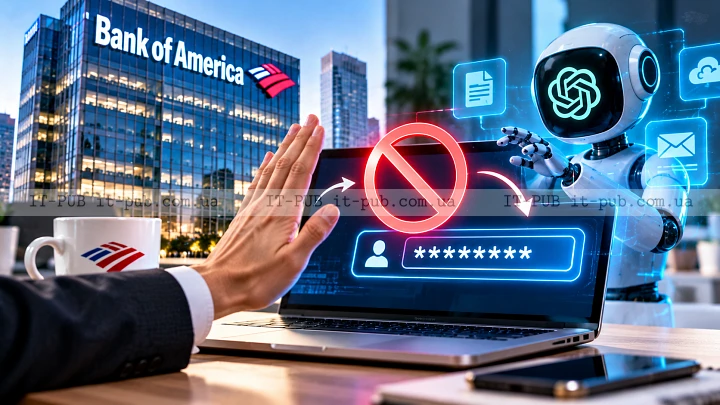
The bank says customers should not give log-ins to AI tools or agents, warning that doing so could lead to fraud, suspicious activity, or account lockouts.
Bank of America is warning customers not to share banking credentials with AI assistants or other outside services. The reminder came in an email titled “Protecting your finances in the AI World,” as more people try personal AI tools that can act on their behalf. For a bank, that creates a clear risk. A tool built for convenience could end up with access to one of the most sensitive parts of a customer’s digital life.
The message itself is direct: never give a username and password to another person or an external service, including “an AI-enabled tool or agent.” As IT-PUB News notes, the warning lands at a moment when AI assistants are moving beyond chat and into tasks tied to shopping, payments, and other financial activity.
Bank of America draws a clear line on AI account access
The warning points to a basic but important problem. If a customer gives an AI assistant access to a bank account, the tool could potentially do something with that account without the customer fully realizing it. In a worst-case scenario, the bank could detect unfamiliar activity and block access to protect the account, leaving the customer locked out.
There is also a broader security concern. If an AI assistant has a flaw, it could expose banking credentials somewhere else. That would create an opening for hackers looking for financial access, not just personal data.
Bank of America’s email suggests the bank wants customers to think twice before treating an AI assistant like a trusted helper with full access to sensitive accounts. The message comes as the line between a digital assistant and a service that can actually act for a user is getting harder to separate.
AI agents are edging closer to payments and purchases
The warning arrives while banks are still trying to work out how AI agents should fit into financial services. According to the source, banks, payment providers, and processors are still working through how customers might use AI tools for account-related actions.
One example mentioned is “agentic payments,” where a person can set an AI agent to buy something automatically at the best price or at the right time. That kind of automation may be convenient. It also raises questions about control, authorization, and responsibility once money is involved.
Bank of America’s email shows that the debate is no longer just theoretical. Customers are already sharing log-ins with personal AI assistants more often, and financial institutions are being pushed to respond before the practice spreads further.
Customers remain responsible for activity on shared accounts
The bank also made clear that customers should not expect to avoid responsibility if they hand over their credentials. A spokesperson confirmed the authenticity of the email after it was posted on social media, and the message points to a standard banking principle: if customers share their log-in details, they remain responsible for activity that follows.
That changes the issue from one of convenience to one of accountability. If an AI assistant makes a purchase, triggers suspicious activity, or otherwise interacts with the account, the customer may still be on the hook under the bank’s account terms.
The email puts it plainly: “If you do share your credentials,” it says, “keep in mind that you’re responsible for activity resulting from that access.”
A practical warning as AI tools spread into daily banking
The notice is not about banning AI tools altogether. It draws a boundary around one of the most sensitive things a customer can share — a banking password. For everyday users, the message is straightforward: AI assistants are not the same as bank-approved access methods, even when they promise convenience.
That distinction may matter more as AI tools spread further into daily life. The more tasks people hand over to software agents, the more important it becomes to know who can access an account, what a tool is allowed to do, and who carries the risk if something goes wrong.
For now, Bank of America’s position is cautious and simple: keep your credentials private, even if an AI assistant says it can help.