Apple Pay enters India with a limited rollout
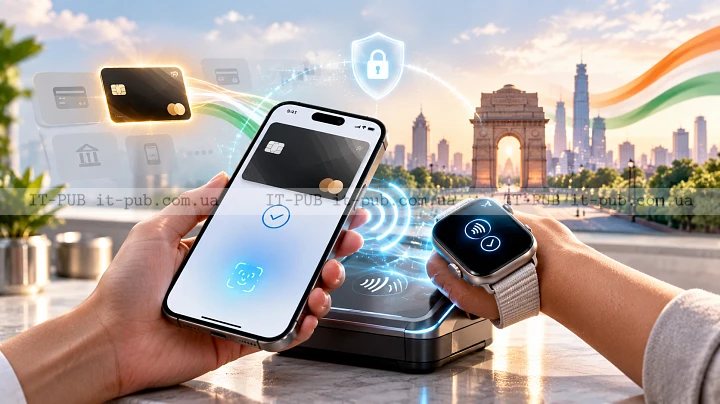
The service starts with Axis Bank cards on Visa and Mastercard, while wider acceptance still depends on merchant terminals and bank deals.
Apple has begun rolling out Apple Pay in India, finally bringing the service to one of the world’s largest digital payments markets. The move is notable, but it lands in a country where the state-backed UPI system already dominates everyday digital spending. Apple’s entry is also narrow at launch, with support limited to selected cards, merchants and payment terminals. Commercial terms with some major banks still appear to be one of the main obstacles.
Axis Bank is Apple’s first partner in India
The initial rollout starts with Axis Bank, India’s third-largest private-sector lender. Eligible Axis Bank customers can add their credit cards to the Wallet app and use Apple Pay for online shopping and contactless payments at supported terminals.
For now, the service works only with eligible Axis Bank cards on Visa and Mastercard. India’s homegrown RuPay network is not part of the launch.
Apple said the service will be accepted by “millions of merchants” across India, naming Blinkit, Croma, Ixigo, Reliance brands, Tata 1mg and Zomato among them. It has also worked with payment service providers including Cashfree, JusPay, Mswipe, Paytm, PayU, Pine Labs, Razorpay and Worldline to enable acceptance.
Merchant support will vary in the early phase
Apple Pay is now live in India, but that does not mean it will work everywhere card payments are accepted. Acceptance depends on whether merchants and payment terminals have been enabled for the service.
So a transaction may go through at one terminal and fail at another, even inside stores that already accept cards. According to IT-PUB News, one person familiar with the matter said acceptance could be uneven in the early phase because the terminal’s acquiring bank also needs to support the service.
That helps explain why the launch took so long. Unlike UPI, which lets users send money directly between bank accounts, Apple Pay is card-based. As a result, it depends much more heavily on individual banks and payment infrastructure providers agreeing to integrate it.
Apple Pay enters a market shaped by UPI
Apple Pay is arriving in a market that looks very different from the card-heavy countries where the service is already established. In India, digital payments have been driven mainly by UPI, the state-backed system for instant bank-to-bank transfers without cards.
UPI is now deeply embedded in daily life, with QR code payments commonplace across the country. Apple Pay, by contrast, is entering a much smaller card payments segment.
That matters for both scale and speed. Apple is not stepping into a market waiting to be remade. It is trying to carve out space in an ecosystem that already has a widely used default payment method.
Talks with major banks are still unresolved
The rollout also arrives with a commercial dispute in the background. People familiar with the matter said Apple has been seeking a fee of about 20 basis points, or 0.2%, on transactions.
That would represent a meaningful share of the payments layer’s margin, which the people said is roughly 40 to 50 basis points, or 0.4% to 0.5%. The fee structure is said to be broadly in line with Apple Pay’s model in other markets.
Not all major banks are participating at launch. HDFC Bank, ICICI Bank and SBI Card are not supporting Apple Pay yet, with negotiations over commercial terms still ongoing, one of the people told TechCrunch.
Apple, Axis Bank, HDFC Bank, ICICI Bank and SBI Card did not respond to requests for comment on the launch.
Apple may see value even without mass adoption
Even if Apple Pay remains a niche service in India, the market could still matter financially for Apple. The company already has a growing iPhone user base in the country, and those users tend to be more affluent and more likely to hold premium credit cards.
That gives Apple a potential way to earn more from its installed base, even if Apple Pay does not become a mass-market payment tool. The people familiar with the matter said the transaction fee would offer Apple another route to monetize iPhone users in India.
The launch also fits Apple’s broader expansion in the country. The company has been increasing iPhone sales, local manufacturing and its retail presence in India.
A cautious debut in a huge payments market
Apple’s arrival adds another piece to a business that is already growing in India, but it does not change the country’s payments landscape for now. UPI remains the main driver of digital transactions, while Apple Pay begins with a limited set of supported cards, banks and terminals.
The move still stands out because it shows Apple pushing deeper into a market where its hardware business is already expanding. Apple accounted for 28% of India’s smartphone market by value in 2025, up from 23% a year earlier, according to a previous Counterpoint Research report.
India is also already an important production hub for Apple. The country accounts for about a quarter of global iPhone production, and that share could rise to 30% to 35% over the next five years, according to a report last month by Business Standard citing an Indian government official.
For now, Apple Pay’s India debut looks more like a careful first move than a full-scale launch. The service is live, but how far it reaches will depend on how quickly banks, merchants and payment infrastructure providers decide to support it.