Apple adds M5 Ultra and M6 to new Macs
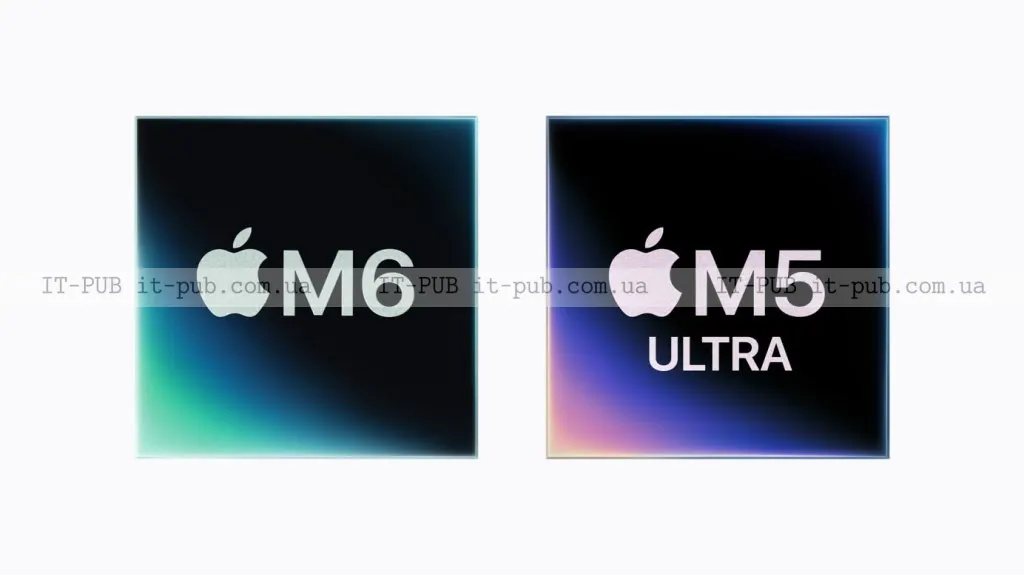
The new chips will power Mac Mini and Mac Studio models, with Apple emphasizing faster on-device AI and a top-end option for demanding pro work.
Apple has introduced two new processors for its Mac lineup: the M5 Ultra and the M6. The chips will power the company’s new Mac Mini and Mac Studio models, with Apple framing the launch around a clear idea — more AI work handled directly on the device. That gives the announcement weight beyond a routine chip update, especially as Apple keeps pushing local processing as part of its broader hardware strategy.
The move speaks to very different Mac users at once. The M5 Ultra is aimed at high-end buyers who need serious computing power, while the M6 is meant to bring faster AI performance to more everyday users and developers. As IT-PUB News notes, Apple is once again leaning on a familiar approach: keeping sensitive and demanding tasks on the device instead of sending them to the cloud.
Apple’s M5 Ultra is aimed at the most demanding Mac users
Apple describes the M5 Ultra as its “most powerful chip ever.” It combines two dual-die M5 Max chips to create Apple’s first quad-die chip, a design the company says is intended to handle demanding AI workloads.
The chip includes up to a 36-core CPU and up to an 80-core GPU. Apple also says it offers 1.2 TB/s of unified memory bandwidth, which is 50% more than the M3 Ultra released about a year and a half ago.
Apple says the M5 Ultra is built for professional tasks such as complex 3D rendering, visual effects, and running frontier AI models. That puts it squarely in the category of hardware for users who regularly push their machines hard, not for casual use.
Even so, the Mac Studio with M5 Ultra may also appeal to hobbyist AI developers, not just studio professionals. That helps explain why the chip drew attention beyond the headline performance numbers.
The M6 focuses on broader on-device AI use
If the M5 Ultra is Apple’s heavyweight option, the M6 is the chip the company is pitching for broader, everyday AI use. Apple says it was built using a 2 nm process and includes a new CPU complex, two additional CPU and GPU cores, a Dual 16-core Neural Engine, and more unified memory bandwidth.
Apple vice president of Silicon Engineering Sri Santhanam said in a press release that the chip is designed to deliver “amazing energy efficiency” while handling workloads more smoothly.
The M6’s 12-core CPU complex adds two more cores than the M5. Apple says that gives the chip nearly a 30% increase in peak GPU compute for AI compared with the M5. The company ties that gain to faster prompt processing when users work with on-device LLMs.
That detail points to what Apple is trying to optimize: AI features that run locally on the Mac itself, rather than relying entirely on remote servers.
Apple is pushing local AI as part of its Mac strategy
The announcement also reflects a broader strategic choice. Apple has lagged behind some competitors in building its own proprietary AI model. The source notes that the long-awaited Siri upgrade is powered by Google’s Gemini.
At the same time, Apple has been strong in using on-device technology for features such as Face ID and Touch ID, where local processing helps protect privacy. Now the company is applying that same logic to AI.
Apple says its developer tools and frameworks can automatically optimize performance across the CPU, GPU, and Neural Engine. It also says developers can use Apple Foundation Models, App Intents to access Apple Intelligence features, or their own proprietary AI models to build and run AI workloads entirely on device.
For developers, that suggests a controlled environment for experimenting with AI tools without depending fully on cloud infrastructure. For users, it may mean faster responses and more privacy-friendly processing in some tasks, although the source does not mention any new consumer features beyond the chips themselves.
New Mac Mini models are up for preorder
Apple said its newest Mac Mini devices are available for preorder now, with prices starting at $899. Shipping begins after September 22.
The company’s Mac Studio model with M5 Ultra was also part of the announcement, though the source does not provide pricing or release timing for that machine.
For Apple, the launch marks another step in its long transition to its own silicon across the Mac line. For the wider market, it shows how central AI has become to chip design — not just in data centers and phones, but in personal computers as well.