Sony Music and Warner sue Anthropic over Claude
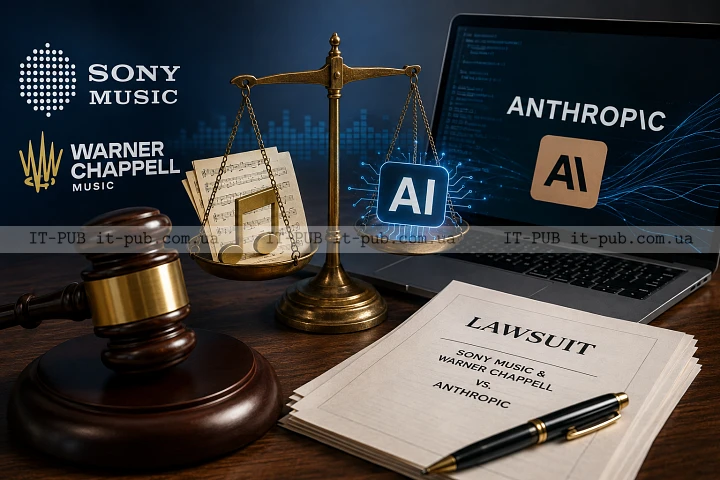
Publishers accuse Anthropic of pirating copyrighted works to train Claude, while the company rejects the claims and says it will fight them in court.
Sony Music Publishing, Warner Chappell and a group of other music publishers have sued Anthropic, accusing the AI company and its co-founders of illegally obtaining copyrighted works to train its Claude model. The case was filed late Friday in the U.S. District Court for the Northern District of California, adding to the pressure on Anthropic as copyright fights around generative AI keep spreading.
The publishers say Anthropic ran a “brazen campaign” of illegally torrenting, scraping and downloading protected material. They call the alleged conduct “blatant theft” and argue that thousands of copyrighted works were used in training. Anthropic disputes the claims and says it will defend itself “robustly” in court, as IT-PUB News reports.
Music publishers widen their case against AI training
The lawsuit names Anthropic as well as co-founders Dario Amodei and Benjamin Mann. According to the publishers, the company did not rely only on licensed material or publicly accessible content, but used copyrighted works without permission.
That matters because training AI systems often requires huge amounts of text, music and other material. For publishers, the issue is not just whether AI models can learn from copyrighted works, but how that material was obtained in the first place. In this case, the complaint centers on alleged piracy and unauthorized downloads.
The filing was first reported by Music Business Worldwide. It adds to the legal pressure Anthropic is facing from the music industry, which has become more active in challenging how AI companies collect training data.
Claude returns to the center of a copyright clash
The publishers say the disputed material was used to train Claude, Anthropic’s AI model. That puts the company back at the center of one of AI’s biggest legal disputes — whether developers can build products on top of copyrighted content, and under what conditions.
This is not Anthropic’s first intellectual-property fight in court. Some of the lawyers in the new case also represent Concord Music Group and Universal Music Group in another lawsuit filed in January. They were also involved in the Bartz v. Anthropic case, where a group of authors accused the company of using copyrighted works to train products including Claude.
Taken together, the cases show the conflict is not limited to one industry. Writers and music publishers are pressing the same basic complaint: that creative work may be used to power AI systems without authorization or compensation.
A previous ruling focused on how the material was obtained
The new complaint follows a major development in the Bartz case. Anthropic was ordered to pay $1.5 billion after a judge ruled that while it was legal for the company to use copyrighted works, it was not legal to obtain that content through piracy.
That point could matter in this dispute too, because the music publishers make a similar argument. They accuse Anthropic not simply of using copyrighted material, but of acquiring it through illegal torrenting and other unauthorized downloading.
The latest lawsuit is described as broader than the earlier cases. It also alleges “flagrant piracy” involving millions of copies of books, including works containing lyrics and sheet music. For the music business, that raises the stakes, since lyrics and sheet music are core assets.
The case could shape how AI companies gather data
The lawsuit points to a wider problem for the AI industry. Companies building large language models need enormous datasets, but the source of that material is now facing closer legal scrutiny. If courts continue to draw a line between lawful use of copyrighted works and unlawful acquisition of them, AI developers may face tighter limits on how they collect training data.
For publishers and other rights holders, the case is part of a broader push to protect creative work in the age of AI. The outcome could affect not only Anthropic, but also how other AI companies approach books, lyrics and other copyrighted content.
For now, the claims remain allegations, and Anthropic has rejected them. Still, with music publishers joining authors and other rights holders in court, pressure over AI training data is continuing to build.