Mistral raises €3B for its sovereign AI push
The French AI lab says the Series D round will fund compute, infrastructure, commercial growth and expansion across more markets.
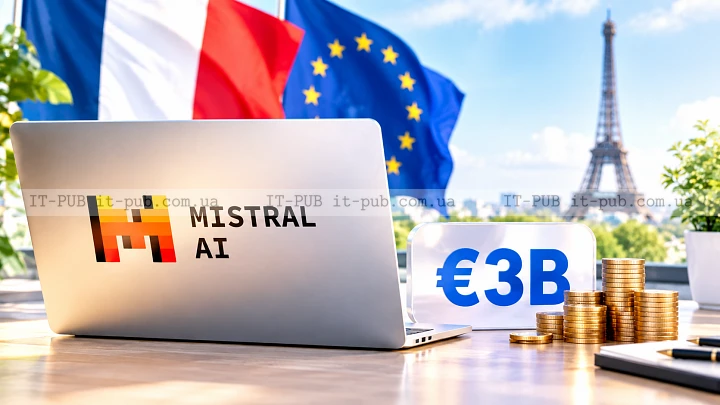
French AI lab Mistral AI has raised €3 billion, or about $3.58 billion, in a new funding round that values the company at more than €21 billion. The deal confirms earlier rumors and stands as one of the biggest financing events yet for a European tech company. IT-PUB News reports that Mistral plans to use the money to expand compute capacity, build infrastructure, accelerate commercial growth and widen its international footprint. The Series D round was led by Samsung Electronics, with EQT-managed Scaleup Europe Fund and existing investor PSG Equity joining as co-leads.
Mistral calls it a record European tech fundraising
Mistral described the deal as “the largest equity fundraising round ever completed by a European technology company.” That helps explain why the announcement drew attention well beyond the AI sector.
The size of the round also shows how expensive the race for advanced AI has become. Building and running large AI systems requires heavy spending on computing power, data-center infrastructure and global sales efforts. For Mistral, the new capital creates more room to compete while still presenting itself as an AI lab, not a mass-market chatbot maker.
The company said the funding will also support its broader commercial push. Even though its models have not become mainstream, Mistral continues to frame its work around research, infrastructure and enterprise use rather than trying to present itself as a “European ChatGPT.”
Sovereign AI stays at the center of Mistral’s pitch
The funding round also underscores Mistral’s growing role in the debate over sovereign AI — the idea that countries and companies should have more control over the AI systems and infrastructure they rely on.
That issue has become more prominent in Europe, where concerns about dependence on U.S. technology continue to shape policy and business decisions. Mistral’s new funding could strengthen a strategy aimed at addressing those concerns, especially as AI regulation and product choices become more politically sensitive in the United States.
In August, the company unveiled tools that let customers choose which regions their AI queries are processed in. It has also started hosting third-party open-weight AI models, including Chinese ones, to support its positioning as an AI services provider that gives customers more control over which models they use and how they use them.
Mistral said on Tuesday that its frontier research is “the foundation underpinning its infrastructure, products and sovereignty.” The wording appears aimed at critics who saw the hosting of Chinese models as a sign that the company was shifting into a more basic inference business.
Macron links the round to France’s AI strategy
The round also carries political weight. French President Emmanuel Macron commented on X that the financing reflected France and South Korea’s goal of “building a third way in AI.”
That reaction shows how closely Mistral’s growth has become tied to broader questions of industrial strategy and digital independence. The company is often viewed as a French tech champion, and Samsung’s role in the deal has the blessing of French authorities.
The geopolitical angle has arguably helped Mistral as much as its technology. The company says it now operates in 20 countries, and its go-to-market strategy focuses on helping governments and corporations use AI while keeping a sense of control. That differs from the broader consumer-facing approach taken by frontier labs such as OpenAI and Anthropic.
According to the source, being outside the U.S. has also reportedly boosted Mistral’s revenue as demand grows for sovereign AI infrastructure. At the same time, the company still faces the reality that the capital needed to compete with leading American labs is difficult to find in France alone.
International backers support Mistral’s broader AI play
Mistral’s cap table remains international, and that matters too. Alongside Samsung, the round included support from existing American backers such as a16z, Nvidia and Salesforce Ventures, as well as new investors Advent and BlackRock.
The company also continues to work with U.S. players, especially Microsoft, through a strategic partnership that the two companies expanded significantly in July. So Mistral’s strategy is not about cutting ties with American tech. It is about balancing those relationships with a stronger European identity and a more control-oriented product offering.
The new financing also follows other important partnerships in Europe, including with Dutch chipmaker ASML. The source compares that approach to Germany’s Aleph Alpha’s merger with Canada’s Cohere, suggesting that Mistral is trying to build a similar international path rather than relying on one national market alone.
For customers, the practical significance is fairly clear: a better-funded Mistral may be able to offer more infrastructure, more regional control and a wider range of model options. For Europe, the bigger question remains whether a homegrown AI company can scale enough to matter in a market still dominated by U.S. giants.
This round does not settle that argument. But it does suggest that sovereign AI is moving beyond policy language and into a more concrete business model, with Mistral emerging as one of its clearest tests.