Apple’s new iPhone arrives in India in 10 minutes
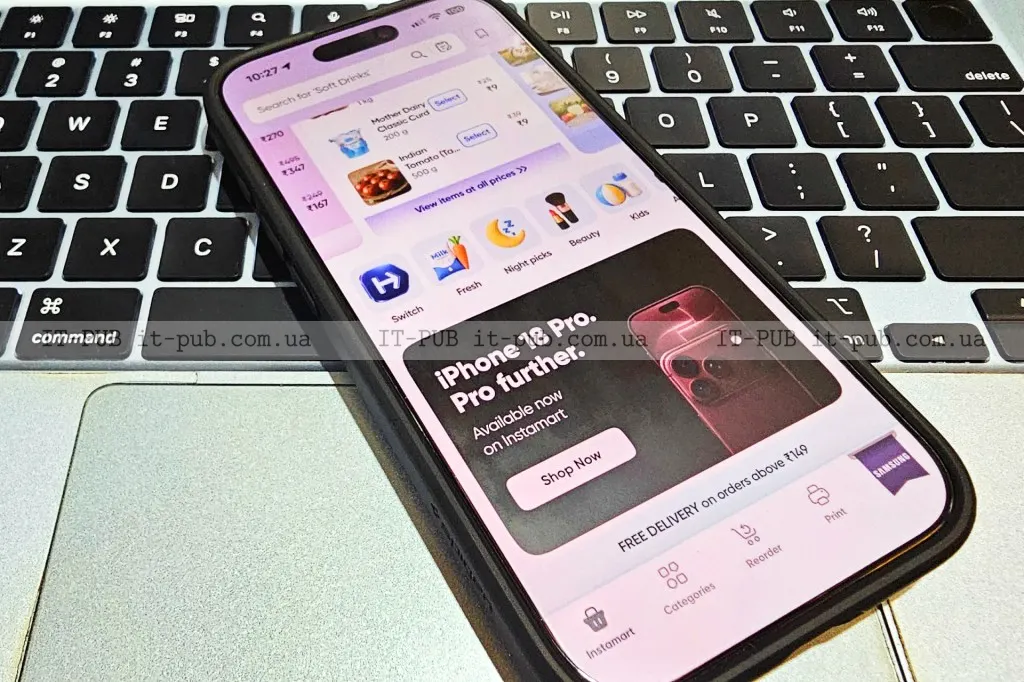
Quick-commerce apps in India started selling iPhone 18 Pro models on launch day, putting premium phones alongside groceries and other fast deliveries.
In India, the new iPhone 18 Pro and iPhone 18 Pro Max could reach some buyers in about 10 minutes after launch. Instead of lining up at stores or relying only on traditional retail, customers could order the phones through quick-commerce apps better known for groceries and other daily essentials.
That matters because it shows how far these delivery platforms have moved beyond food and household basics. It also raises a practical question for the smartphone market: can an app built around instant delivery become a real channel for expensive electronics, or is this mostly a launch-day play?
Quick-commerce apps put the new iPhone on sale
Blinkit, Zepto, Swiggy’s Instamart and BigBasket all began offering the new Pro models when the phones went on sale in India on Friday. The devices appeared on the same platforms many people already use for fast delivery of groceries and other essentials.
Apple’s phones were not limited to those apps. Buyers could also purchase them through Apple’s own stores, authorized retailers and online marketplaces. The quick-commerce option simply added another route for customers who wanted the newest model right away.
This was not the first time Apple’s latest devices had shown up on such platforms in India. Quick-commerce companies have offered iPhones on launch day before, expanding steadily beyond groceries into categories including electronics, beauty products and fashion.
A fast-growing market sits behind the launch
The timing also reflects the rapid growth of India’s quick-commerce sector. A recent report by Redseer Strategy Consultants valued the market at about $9 billion in the first half of 2026. Monthly users have also climbed sharply, reaching more than 60 million from 8 million three years ago.
Other forecasts suggest the market still has room to grow. Google and Deloitte separately estimate it could reach $50 billion by 2030. They also say non-food products such as electronics, fashion and beauty could account for 45% of spending.
That helps explain why selling a premium phone through a delivery app is getting attention. As IT-PUB News notes, it is not just about launch-day visibility. It also signals that quick-commerce companies want a bigger role in higher-value shopping, not only in everyday top-up orders.
Early demand was strong, but stock thinned out in places
There were early signs of strong demand. BigBasket said it delivered more than 300 iPhone 18 Pro and Pro Max units in the first hour of sales. Instamart told TechCrunch that Bengaluru led orders for the iPhone 18 Pro series on its platform, followed by Delhi.
Instamart also said the Burgundy 256 GB iPhone 18 Pro was its most popular variant, accounting for nearly a third of its sales.
Still, the launch-day rush did not hold everywhere. Within hours, availability had become uneven. TechCrunch found that iPhone 18 Pro models were sold out on some quick-commerce platforms and in some locations, while they remained available for delivery in other parts of cities such as Delhi and Bengaluru.
That patchy picture suggests the service can handle bursts of demand, but it also shows the limits of a model built around very fast fulfillment. For a product as popular as the iPhone, stock can disappear quickly when demand jumps.
Analysts see proof of concept, not a major sales channel
Tarun Pathak, research director at Counterpoint Research, said the launch-day deliveries showed quick commerce can work as a channel for premium smartphones in India’s biggest cities, even if volumes remain small compared with overall iPhone sales.
He called the ability to fulfill high-value smartphone orders an “early proof of concept.” But he also said the key question is whether launch-driven demand can turn into regular smartphone purchases through quick-commerce platforms.
Navkendar Singh, associate vice president at IDC, said India stands out globally for this kind of delivery. In his view, the country is particularly suited to it because consumers in major cities have built trust in quick-commerce platforms through regular use for everyday purchases.
He also pointed to official tie-ups between brands and the platforms as another factor that can make shoppers more comfortable buying expensive products this way. For buyers, Singh said, the appeal is partly about “instant gratification” — avoiding queues outside stores or waiting several days for an online order.
At the same time, he warned that quick commerce is still not a major smartphone sales channel. In his view, its role around new iPhone releases is mainly a “launch-day marketing phenomenon” that “creates good noise around the launch.”
Why the iPhone delivery model stands out in India
The appeal is easy to see. It combines a high-profile consumer product with a delivery system built for speed. For some buyers, that means the newest iPhone can arrive almost as quickly as a food order.
But the same speed that makes the idea attractive also sets limits. The early sales figures, uneven availability and analysts’ comments all point in the same direction: quick-commerce apps can draw attention and handle a burst of premium orders, yet it remains unclear whether they can become a stable, everyday route for smartphone sales.
For now, the launch shows how India’s fast-delivery platforms are pushing further upmarket. It also shows how thin the line can be between convenience shopping and big-ticket electronics — at least on launch day.