Meta AI brings system-wide dictation to Mac
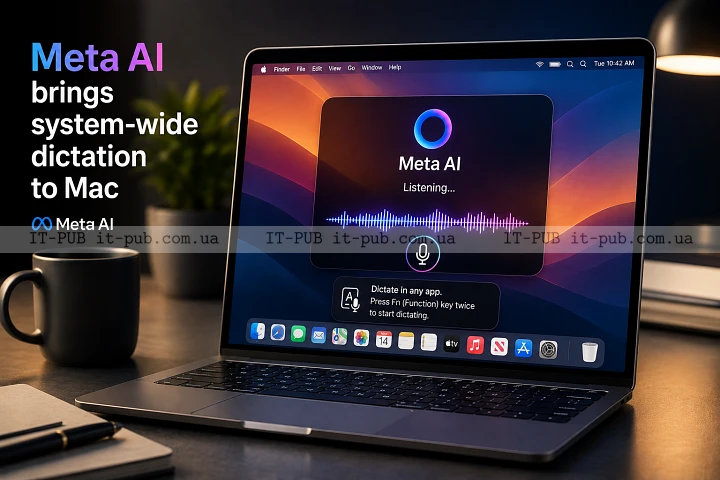
The new Mac app can answer questions about what’s on screen, while business users can link Meta ads, Instagram, Facebook, and Google Workspace.
Meta has launched a new Mac app for Meta AI, adding two features that push the assistant beyond a standard chat window: system-wide dictation and screen-aware answers. The app can work across other apps on a Mac, and it can check what is currently on screen before replying to a user’s question. That makes the release relevant not just for casual use, but for work that moves between documents, messages, and business tools. It also shows Meta trying to make Meta AI more useful for both personal productivity and day-to-day business tasks.
Meta AI expands beyond a single app on macOS
Meta said the new dictation feature works across all apps on macOS, similar to tools such as Wispr Flow, Superwhisper, and Monologue. Users do not have to stay inside one specific app to speak text aloud.
The idea is simple: let people dictate wherever they are already working, instead of switching between tools or copying text from one place to another. That could make writing feel quicker and less repetitive.
Meta also said the app can use its Muse Spark model to inspect the current screen and answer questions based on what it sees. As IT-PUB News notes, the company did not describe this as a general-purpose vision feature for everything on the computer, but as a way to provide context-aware responses inside the app.
Business users can link Meta ads and Google Workspace
The Mac app is also part of a broader Meta AI update aimed at business owners. Meta said merchants can connect their Instagram and Facebook accounts, Meta ad campaigns, and Google Workspace accounts, including Gmail, Docs, Sheets, and Slides.
Once those accounts are connected, users can ask Meta AI for insights from those services. According to Meta, the assistant can provide information about campaign performance and audience engagement metrics, helping users see which posts performed well.
Meta also said the system can surface intelligence about competitors using publicly available data. That could be useful for businesses trying to track their position in a crowded market, though the company said the data is limited to what is publicly available.
The integrations are not limited to analysis. Meta said the assistant can also create proposal decks, draft documents, and build spreadsheets, turning it into a tool for routine office work as well as reporting.
Meta ties the update to its broader business AI push
The release fits a larger direction Meta has been taking with its AI products. The company has been putting more focus on AI for automated customer support and inquiries across its apps, including WhatsApp and Instagram.
That business focus also came up during Meta’s Q2 2026 earnings call. CEO Mark Zuckerberg said there is a big opportunity to sell agents to businesses and automate work on their behalf.
Taken together, the new Mac app and the business integrations suggest Meta wants Meta AI to be more than a consumer chatbot. The company is positioning it as a layer that can sit between messaging, ads, office files, and everyday tasks.
The update adds convenience but leaves access questions open
The practical appeal is easy to see. A Mac app that can dictate across programs, read the current screen, and pull in business data could cut some of the friction that comes with moving between tools. For merchants and marketers, it may make checking campaign results, drafting materials, and comparing performance easier without bouncing between multiple dashboards.
Still, the update brings familiar questions about how much access an AI assistant should have. A screen-aware tool and connected business accounts can be useful, but they also depend on access to sensitive work information. Meta’s announcement lays out what the features do, but it does not go into detail about how users will manage that access.
For now, the release points to where Meta wants to take its AI products: deeper into personal workflows, more closely tied to its own platforms, and increasingly focused on businesses.