Google makes AI watermarks optional in Gemini
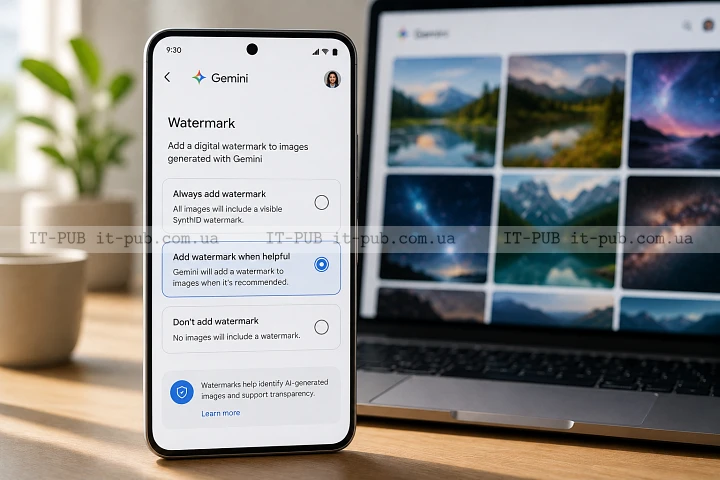
Users will soon be able to hide visible labels on AI-made images, videos, and songs, while Google keeps SynthID and C2PA markers in place.
Google is changing how it labels AI-generated content across some of its tools. Users will soon be able to remove the visible watermark from images, videos, and songs created with Google’s AI systems, while the company keeps hidden identification markers in place. The shift matters because visible labels can help people spot AI-made media quickly, but they can also get in the way when content is used professionally or shared more widely.
Google is effectively trying to do both at once: preserve a way to identify synthetic media and give users more control over how that media appears. As IT-PUB News reports, the company says the hidden labels will remain even when the visible watermark is switched off.
Visible watermark becomes a user setting in Gemini and Flow
Josh Woodward, Google’s VP for Gemini, said in a post on X that the option will apply to the Nano Banana, Omni, and Lyria models. He said the setting will be available in Gemini and in Google’s video editor, Flow, with support for Search coming soon.
Once the feature rolls out, users will be able to open Settings and turn the visible watermark on or off under Media Watermark. Google said the change will begin rolling out in the coming days.
So the visible mark will no longer be fixed on every AI-generated result in the supported tools. For people creating content for work or publication, that could make the output easier to use without a branded overlay. For viewers, though, it also means the label may no longer be obvious at first glance.
Google keeps SynthID and C2PA labels behind the scenes
Google said the update applies only to the visible watermark. The invisible SynthID watermark and metadata tied to the C2PA standard will stay in place.
In practical terms, the company says people will still be able to use Gemini or Search to check whether an image was AI-generated. Google is presenting the change as a compromise between creative flexibility and safety.
That difference matters. A visible watermark is easy to notice immediately, but it can also be hidden from view. Hidden markers are less apparent, yet Google is treating them as the main transparency tool even when the visible label is disabled.
Google shifts its approach to labeling synthetic media
The announcement signals a broader adjustment in how Google handles labeling for AI-generated media. Visible watermarks can make synthetic content easier to identify quickly, but they can also make that content less practical for artists, editors, marketers, and others who want to reuse or publish it.
Google’s approach suggests it wants to address those concerns without abandoning labeling altogether. Rather than requiring a visible mark on every generation, the company is making that layer optional while keeping its less visible identification systems active.
Google has not said the visible watermark is disappearing entirely for all users. It is becoming a setting, so the result will depend on how someone wants to use the content and which tool they are using.
Google’s move lands after Anthropic’s watermark push
The announcement follows a different decision from Anthropic, which drew attention after adding a watermark to text and files generated by Claude to comply with EU regulations.
The contrast shows how unsettled AI labeling remains. Some companies are moving toward stronger and more visible disclosure, while others are trying to reduce the visual impact of those labels without dropping transparency tools.
Google’s update does not settle that argument. It does show that AI companies are still trying to find a workable balance between making synthetic content identifiable and keeping it usable in everyday settings.